Your Crew Is Your Creatine: How Your Social Circle Makes or Breaks Your Gains
You've tracked your macros. You've periodized your training. You've bought the knee sleeves, the chalk, and the foam roller you only use when someone's watching. And yet, somewhere around month four, the numbers on the bar stop climbing and the motivation starts leaking out of you like air from a cheap tire.
Most guys look inward when progress stalls. They tinker with their split, second-guess their protein intake, or convince themselves they need a deload week. Fair enough — those things matter. But there's a variable that almost nobody audits, and it might be the most powerful one in your entire training ecosystem: the people around you.
Your social circle isn't just background noise. It's fuel — or it's friction.
The Science of Who You Train Around
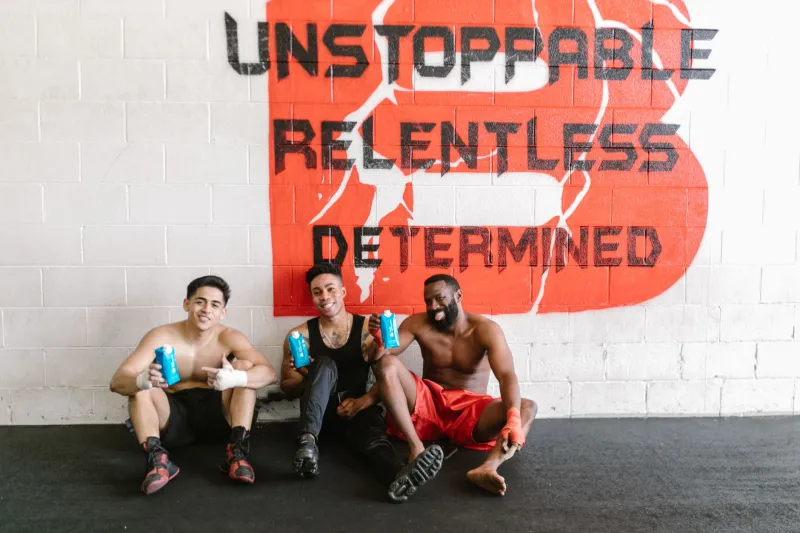
Research out of the University of Oxford found that people who exercise in groups have significantly higher pain thresholds than those who train solo. The mechanism? Endorphin release is amplified through social bonding. In plain English: being around the right people literally makes hard things feel easier.
Then there's the well-documented Köhler effect — a phenomenon where individuals push harder when paired with someone slightly stronger or more capable than themselves. It's not about competition exactly. It's about elevation. When the guy next to you pulls 405, your 365 doesn't feel like a ceiling anymore. It feels like a stepping stone.
Flip that coin, though. Surround yourself with guys who are comfortable being comfortable, who celebrate rest days more than PRs, who bail on training when the weather gets a little sketchy — and that energy seeps in. Not because you're weak-minded, but because humans are wired to mirror the behavior of their tribe. It's evolutionary, not personal.
Accountability Isn't Just Showing Up
Here's where a lot of men get it wrong. They think accountability means having someone to text when they skip leg day. That's not accountability — that's a hall monitor.
Real training accountability is layered. It's the training partner who notices you've been grinding at 225 for six weeks and asks what your actual plan is. It's the guy who calls out your half-rep squats not to embarrass you, but because he respects you enough to hold the standard. It's the friend group that doesn't let you romanticize your excuses.
A study published in the Journal of Sport & Exercise Psychology found that having a specific, committed workout partner — not just a gym buddy — increased training frequency by up to 200 percent over solo trainers across a 12-week period. Two hundred percent. That's not a marginal edge. That's a completely different outcome.
The difference between a gym buddy and a real training partner is investment. One is company. The other is a stake in your progress.
Isolation Wears a Gym Membership
Here's a hard truth that a lot of guys living the lone wolf lifestyle don't want to hear: you can be surrounded by people and still be completely isolated.
Training in the same gym as a hundred other dudes doesn't mean you have a crew. Nodding at the same faces every morning doesn't mean anyone's invested in your growth. Social isolation in fitness isn't about being physically alone — it's about having no one who actually knows where you're trying to go.
And that kind of isolation has real consequences. Beyond performance, research links social disconnection in men to elevated cortisol, disrupted sleep, and reduced motivation across all domains — including training. Your body reads loneliness as a threat. Chronically elevated stress hormones are the enemy of every hormonal environment you need for muscle growth and recovery.
If you're grinding solo, grinding hard, and still spinning your wheels — this might be the reason.
Building a Crew That Actually Moves the Needle
So how do you build the kind of social circle that drives real progress? Start by being intentional instead of passive.
Find your slightly-better guy. Every solid crew has someone who's a step ahead. Not so far ahead that you're demoralized, but far enough that they're pulling you forward. Seek that person out. Buy them a coffee. Ask smart questions. Most guys who are serious about their training respect curiosity and hustle — they'll engage.
Communicate your goals out loud. There's a reason public commitment is one of the most effective behavioral psychology tools around. When you tell real people — not your Instagram followers, actual humans in your life — what you're working toward, you create social stakes. Those stakes are motivational currency.
Audit who you spend training time with. This isn't about cutting people off. It's about being honest. If certain training partners consistently lower your energy, reduce your intensity, or make it easier to skip sessions, you need to limit that exposure. You don't have to ghost them — just be strategic about when and how much you train together.
Invest in your gym community. Spot people. Learn names. Show up consistently enough that you become a fixture. Community doesn't fall into your lap — you build it through repeated, genuine presence. The guy who's always there, always ready, always locked in becomes magnetic. Others want to be around that energy.
Use technology intentionally. Group chats, shared training logs, apps like Ladder or even just a committed Marco Polo thread with your training crew — these tools extend accountability beyond the gym walls. When your partner sends a 6 a.m. video of their deadlift session, it's a lot harder to hit snooze.
The Long Game Is a Team Sport
Look, there's a version of masculinity that glorifies going it alone. The solo grinder. The self-made man. And yeah, self-reliance matters — nobody's going to care about your progress more than you do.
But the strongest men in history — whether we're talking about athletes, soldiers, or builders — didn't operate in isolation. They had a unit. A team. A crew that held the standard when individual willpower ran dry.
Your training is no different. The barbell doesn't care how tough you are when nobody's watching. Progress compounds fastest when you have people in your corner who know your numbers, call your bluffs, and show up even when the schedule gets messy.
If your lifts have stalled, check your programming. Check your sleep. Check your nutrition. But don't forget to check your circle. Because sometimes the strongest thing you can add to your training isn't a new supplement or a new movement pattern.
Sometimes it's a new training partner.
Build strong. Live bold. And don't train alone.