Why Lifting Less Weight Might Be the Most Powerful Thing You Do in Your Thirties
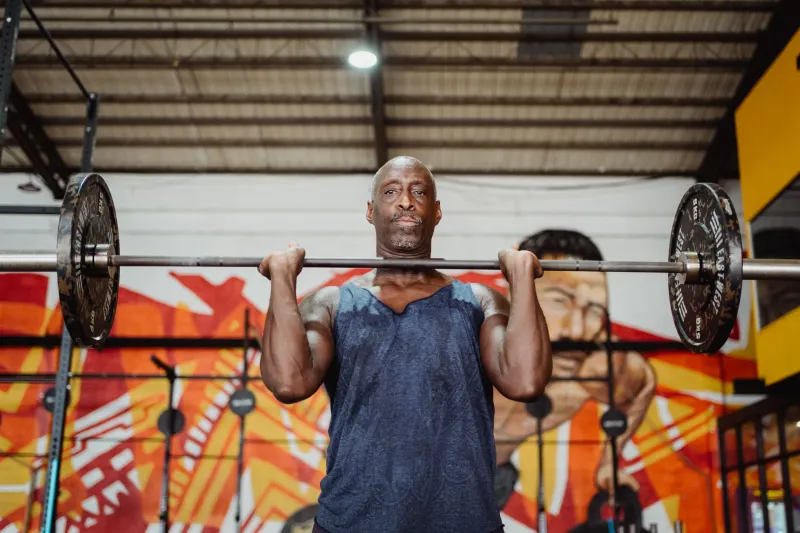
There's a moment a lot of guys don't talk about. You're somewhere in your early-to-mid thirties, loading the bar the same way you always have, and something feels off. Not broken. Not injured. Just... different. The weight that used to feel like a challenge now feels like a negotiation. Your joints have opinions. Your recovery has conditions. And for the first time, you start wondering whether chasing the same numbers still makes sense.
Most men read that moment as decline. It isn't. It's information. And knowing how to use it is the difference between a guy who's still training hard at 55 and a guy who blew out his shoulder at 38 trying to prove something to nobody.
The Numbers Game Was Never Really About Strength
When you're 22 and loading a barbell, the number on the plates is everything. It's identity. It's proof. You want to bench more than your buddy, squat more than last month, deadlift more than the guy across the gym. That's not a character flaw — it's developmental. Young men are wired to establish dominance hierarchies, and the weight room is one of the safest places to do it.
But here's the thing: those numbers were never really measuring strength. They were measuring peak output under optimal conditions — youth, high testosterone, fast recovery, and the ability to absorb punishment your body won't keep tolerating forever. The barbell wasn't building a long-term relationship with your body. It was running a sprint.
Strength, real strength, is something different. It's the ability to generate force consistently, over time, without destroying the machinery you need to keep doing it. That's not a lesser version of what you had at 22. It's a more sophisticated one.
What Actually Changes in Your Thirties
Let's be straight about the biology. Testosterone levels begin a gradual decline starting around age 30 — roughly 1% per year on average, according to research from the American Urological Association. Recovery takes longer. Connective tissue — tendons, ligaments, cartilage — becomes less forgiving. The inflammatory response to hard training lingers a bit more than it used to.
None of that means you're done. It means the rulebook has been updated.
The guys who adapt thrive. The guys who refuse to acknowledge the update end up cycling through injuries, frustration, and eventually the kind of bitterness you see in former athletes who can't stop talking about what they used to lift. That's not a legacy. That's a cautionary tale.
Adapting doesn't mean going soft. It means training smarter — choosing movements that build real-world power without torching your joints, managing volume more carefully, and being honest about recovery needs. It means the work gets more precise, not less intense.
Redefining the Scoreboard
Here's the shift that changes everything: stop measuring strength by what you can max out once and start measuring it by what you can sustain for decades.
A 405-pound deadlift at 23 that leads to a herniated disc at 31 isn't a win. A 315-pound deadlift at 35 that you're still pulling clean at 50 is a completely different story. One of those men is strong. The other one was strong, briefly, and paid for it.
Experienced lifters — the ones worth learning from — tend to shift their attention toward a few key markers that don't show up on a max-effort lift:
Movement quality. Can you squat through a full range of motion with control? Can you hinge without compensating? The ability to move well under load, repeatedly, is a better indicator of functional strength than any single heavy set.
Durability. Are you training consistently without interruption from injury? Consistency compounds. The man who trains 48 weeks a year for ten years will outpace the guy who goes hard for six months and spends the next three on the injured list.
Recovery capacity. How well are you bouncing back? If you're wrecked for four days after a training session, the session wasn't a win — it was a withdrawal from a bank account you can't keep overdrafting.
Strength relative to bodyweight. Absolute numbers matter less as you age. Your strength-to-weight ratio tells a more honest story about how well your body is actually functioning.
The Ego Isn't Your Enemy — It's Just Misdirected
Nobody's telling you to abandon your competitive edge. That drive is an asset. The question is what you're pointing it at.
In your twenties, ego pushes you to lift heavier than the guy next to you. In your thirties and beyond, the smartest men redirect that same competitive energy inward — toward mastery, toward longevity, toward building a body that works well in every context, not just under a barbell.
That's actually harder. It requires more discipline to pull back on a set you could technically grind through than it does to push past the point of good sense. It takes more self-awareness to program for sustainability than to just go heavy and see what happens. The ego work of your thirties is more demanding than the ego work of your twenties — it's just quieter.
Building a Framework That Lasts
If you're somewhere in that 30-to-45 window and trying to figure out how to recalibrate, here's a starting point:
Prioritize the movements that give you the most return with the least systemic cost. Heavy barbell squats and deadlifts aren't going anywhere, but how you program them might change. Higher frequency at moderate intensity often beats low-frequency max efforts for guys managing recovery.
Invest in what you've been ignoring. Mobility, soft tissue work, sleep, stress management — these aren't recovery tools for the weak. They're performance tools for the experienced. The guys who neglect them are the ones who end up sidelined.
Measure progress differently. Track how you feel at the end of a training block, not just what you lifted. Are you moving better? Recovering faster? Feeling capable and energized? Those are the metrics that matter for the long game.
Stop apologizing for the adjustment. You're not lifting less because you've given up. You're lifting with more intelligence because you've learned something. That's not a retreat. That's evolution.
The Real Strength Paradox
The men who look strongest at 50 are almost never the ones who peaked hardest at 25. They're the ones who figured out, somewhere in their thirties, that the point was never the number on the bar. The point was building a body — and a mindset — capable of showing up for decades.
That's the paradox. The guys willing to get strategically weaker in the short term are the ones who end up genuinely strong in the long run. They're still in the gym when their peers are managing chronic pain. They're still moving well when other men their age have started treating the floor like a hazard.
Getting smarter about strength isn't the end of the story. For a lot of men, it's where the real story finally begins.