Brotherhood Over Barbells: How the Gym Became the Last Great Male Bonding Space

Let's get uncomfortable for a second.
According to a 2021 survey by the Survey Center on American Life, the percentage of men with no close friends has quintupled since 1990 — jumping from 3% to 15%. Men are more isolated than at any point in modern recorded history. Suicide remains the leading cause of death for men under 45. And yet the cultural conversation around male mental health still feels like it's happening in a foreign language most guys were never taught to speak.
Here's what nobody's saying loudly enough: the gym might be one of the last places in America where men actually show up for each other.
The Quiet Crisis Nobody's Talking About at the Dinner Table
Isolation doesn't announce itself. It creeps in. You get busy with work, the kids, the mortgage. Your college friends scatter across the country. You scroll Instagram watching people look like they're living their best lives while you're sitting alone on a Tuesday night wondering when everything got so quiet.
This is the loneliness epidemic, and it hits men especially hard. Society has, for generations, conditioned men to equate emotional expression with weakness. You don't talk about feeling disconnected. You don't admit that you miss having guys around. You just... grind through it.
But here's the thing — that grind is costing men their health, their relationships, and in too many cases, their lives. Chronic loneliness carries health risks comparable to smoking 15 cigarettes a day, according to research from Brigham Young University. This isn't a soft issue. It's a physiological one.
Why the Weight Room Works Where Other Spaces Fail
Men bond through doing. It's not a stereotype — it's behavioral science. While women often connect through direct conversation, men tend to build closeness through shared activity and side-by-side experience. That's why the gym is so uniquely suited to forging real male connection.
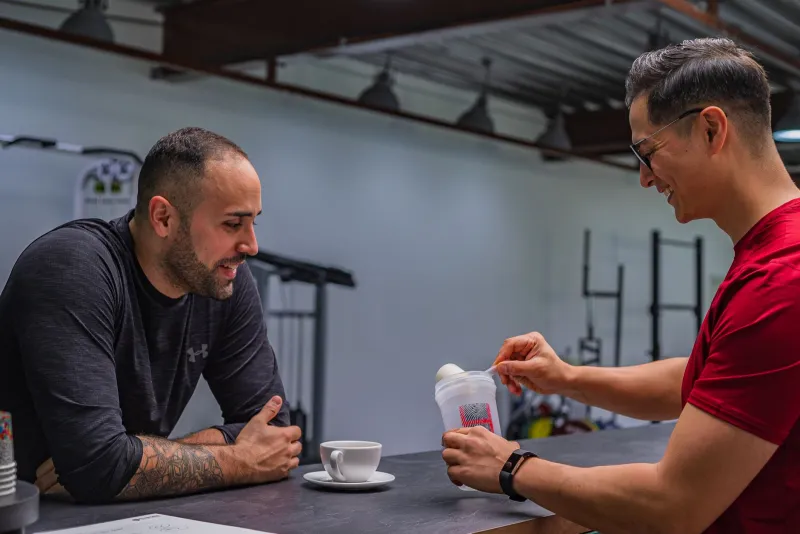
Think about it. You don't have to manufacture a reason to be there. You don't have to make small talk over a cocktail you're pretending to enjoy. You show up, you work, and somewhere between the warm-up and the last set, something real starts to happen. A guy spots you on bench. You return the favor. You swap notes on programming. You give each other grief about skipping leg day. And slowly — without either of you ever having to say the word "friendship" out loud — you've built one.
The shared language of lifting removes the awkwardness that paralyzes a lot of male social interaction. When you're both suffering through a heavy squat session, status and ego dissolve fast. You're just two guys trying to get better. That's a foundation most other social environments can't replicate.
Accountability Partnerships: More Than Just a Gym Buddy
Having a training partner isn't just about getting a spot. Research published in the Journal of Sport and Exercise Psychology shows that working out alongside someone else increases effort output and consistency. But the psychological benefits run deeper than performance metrics.
A real training partner becomes a form of low-key accountability therapy. He knows when you've been skipping sessions. He notices when your head isn't in it. He asks questions — not in a probing, uncomfortable way, but in the casual, shoulder-to-shoulder way men actually respond to. You good? You seem off today. That's often enough to crack the door open.
If you don't have a training partner yet, start looking for one. Post in your gym's community board. Join a powerlifting club or a CrossFit box. Sign up for a group class. Put yourself in an environment where showing up is a shared expectation. The accountability alone will improve your training. The connection that follows might improve everything else.
When the Barbell Isn't Enough — And That's Okay
Here's where we're going to say something that might surprise you coming from a site called Strong Chap: lifting alone won't fix everything.
For a lot of men, the isolation runs deep enough that it needs professional support. And therapy — real, actual talk therapy — has become one of the most underutilized tools in a man's wellness arsenal. Not because men don't need it, but because the stigma around it is still stubbornly strong.
Here's a reframe worth considering: going to therapy is the same as hiring a strength coach. You're bringing in a professional to identify your weak points, give you a structured plan, and hold you accountable to progress. Nobody calls you soft for working with a trainer. A therapist is just a trainer for your mind.
Cognitive Behavioral Therapy (CBT), in particular, has a strong evidence base for treating depression and social anxiety — two conditions that often underlie chronic loneliness in men. Finding a therapist who works with male clients and understands male psychology can be a genuine game-changer. Psychology Today's therapist finder and apps like Hims and BetterHelp have made access easier than ever.
You don't have to be in crisis to go. In fact, the strongest move is going before the crisis hits.
Building Your Circle Intentionally
Strong men build strong environments. That means being intentional about who you're surrounding yourself with and how you're showing up for them.
A few practical moves:
Show up consistently. The gym is a social ecosystem. Regulars recognize each other. Consistency is the price of admission to that community.
Be the guy who introduces himself. Most men are waiting for someone else to make the first move. Be the exception. A simple "good set, man" goes further than you'd think.
Extend the conversation outside the gym. Grab a post-workout meal. Start a group chat about programming. The relationship only deepens when it exists beyond the four walls of the weight room.
Don't front like everything's fine when it's not. Real strength includes the ability to say I'm struggling. The men worth keeping in your corner will respect that more than the performance.
The Strongest Thing You Can Do
The loneliness epidemic is real, it's serious, and it's hitting American men harder than most people want to admit. But the antidote isn't complicated — it's connection, consistency, and the courage to actually show up for yourself and the people around you.
The gym gives you a place to start. The work you do on your mind — whether through therapy, honest conversation, or simply reaching out — does the rest.
Built strong. Live bold. That includes building a life where you're not doing it alone.